Build-for-Share Contracts in Turkey: What Should the Landowner Check?
A build-for-share (kat karşılığı) contract is a long relationship with legal and tax consequences for the landowner. We summarise the form requirement, delivery schedule, security and tax points from official sources.

In Turkish cities an old house or an empty plot can, years later, become a multi-storey building. The most common route is the kat karşılığı (land-for-flats) construction contract: the landowner gives a share of the land to a contractor, and the contractor builds the block and hands over an agreed set of apartments to the owner. On paper it looks simple, but it is a long and risky relationship in which both sides promise property and work to each other. This article lists what a landowner should review before signing, based on the Turkish Code of Obligations and the Revenue Administration (GİB).
What kind of transaction is it?
A build-for-share contract contains two separate performances: the owner transfers land shares, and the contractor builds and delivers units. GİB's VAT application communiqué describes it the same way: in a land-for-flats construction deal there are "two separate deliveries" — first the owner's delivery of a land share to the contractor, and second the contractor's delivery of a dwelling or business unit to the owner.
Article 237 of the Code of Obligations requires the contract for the sale of real estate to be drawn up in official form to be valid. Because a build-for-share contract carries an obligation to transfer land shares, in practice it is expected to be made officially, before a notary or at the land registry; a plain private paper may not give enough security. The safest path is to sign the contract with its annexes, in official form, and with the help of a lawyer or a trusted adviser.
On the work side, the rules on contracts for work (eser sözleşmesi) are also useful. For instance, Article 471 obliges the contractor to work with loyalty and care, and Article 473 lets the client withdraw without waiting for the delivery date when a delay is clearly foreseeable.
Know the contractor before signing
The biggest risk is whether the person or company can actually finish the building. Look at earlier projects, permit and occupancy status, tax and title records, and references. Our article on how to check a contractor offers a detailed list. If it is a company, also review its trade registry record, its signatory authority and its capital.
Clauses that must be clear
Vague wording causes the most disputes later. Each of the following should be written in a clear and measurable way:
- Units due to the owner: floor, orientation, gross and net area, number of rooms, garden or parking share; ideally with a floor plan and unit numbers.
- Project and technical specification: materials, brands or quality classes, thermal and sound insulation, lift, common areas. Make the specification an annex.
- Delivery date and penalty for delay: the start date, permit period, delivery day and the amount payable for delay (for example rent or a daily penalty) should be explicit.
- Timetable for the transfer of land shares: whether all shares are transferred up front or in stages according to construction progress. A staged transfer protects the owner.
- Security: a bank guarantee letter, a mortgage, or an annotation on the units at the land registry reduces the risk of non-performance.
- Sales to third parties: how the contractor will protect the owner's rights when selling its own units. Our articles on contractor consent and notarised assignment may help.
- Costs and taxes: who bears title deed fees, building inspection, permit and common costs.
- Occupancy permit and condominium ownership: who must obtain the occupancy permit and convert the condominium easement into full condominium ownership, and by when.

Photo: Gvido-Galendim / CC BY-SA 4.0 — Wikimedia Commons
After delivery: defects and acceptance
If defects appear after you receive the flat, the Code's rules on contracts for work apply. After delivery the client must inspect the work as soon as the ordinary course of things allows and notify the contractor of defects within a reasonable time (Art. 474). The client then has alternative rights: withdraw from the contract, claim a price reduction or free repair (Art. 475). For claims arising from a defective work, the limitation period for immovable structures is five years from delivery, and twenty years if the contractor was grossly negligent (Art. 478). If you notice a defect at handover, notify it in writing without delay. Our checklist for taking delivery of a new flat can help.
Tax consequences
VAT. According to GİB's VAT communiqué, if a landowner, as an occasional activity that does not require full VAT registration, transfers a land share to the contractor in return for flats or offices, no VAT applies to that transfer. If the land belongs to a business or the owner habitually trades in land, the delivery is subject to VAT. The delivery of the dwelling or office by the contractor to the owner is subject to VAT, with the value determined under the cost-based method described in the communiqué. The applicable rate and calculation can vary with the year and the type of dwelling, so consult an accountant before signing.
Capital gains. In GİB's brochure on real estate sales, the registration of a property obtained by constructing a building on land or by giving the land in return for flats is treated as a "change of type", and the registration date is taken as the acquisition date. If you sell such a flat within five years of registration, the gain may be taxed as a value-increase gain if it exceeds the annual exemption. If you plan to sell, see our article on taxes and the 5-year rule.
Summary checklist
- Sign in official form with a lawyer's help.
- Investigate the contractor's record and finances.
- Annex the unit list, project and technical specification.
- Put the delivery date, delay payment and security in writing.
- Link the transfer of land shares to construction progress.
- Settle who obtains the occupancy permit, creates condominium ownership and pays the taxes.
- Report defects at delivery in writing and without delay.
If you intend to sell or rent after delivery, the occupancy permit and title deed status matter even more; read our articles on the occupancy permit and the difference between kat irtifakı and kat mülkiyeti. The whole path to owning a home in Antalya is summarised on our page buying a home in Antalya.
Sources: Turkish Code of Obligations (no. 6098), text published by the Ministry of Justice (Arts. 237, 471, 473–478); GİB VAT General Application Communiqué ("Land-for-Flats Construction Works" section) and GİB brochure "Taxation of Real Estate Sales" (April 2024).
If you have questions, feel free to write to us.
---
This content is for general information only and is not legal or financial advice. Please consult a qualified professional before making a decision.
Cover photo: Pivox / CC BY-SA 4.0 — Wikimedia Commons
New-build projects for sale in Antalya
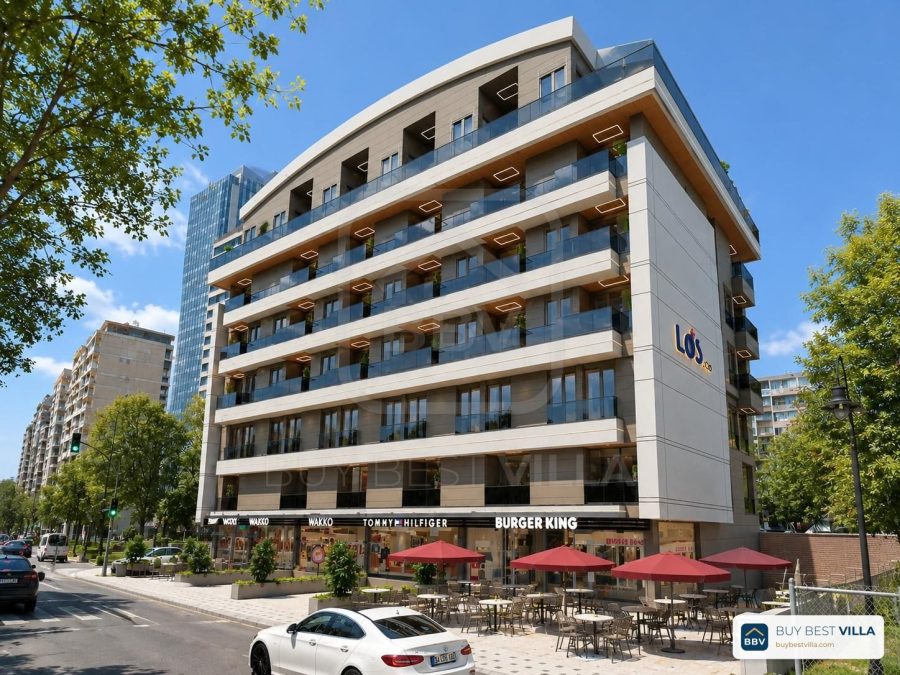
Los Tigres
A boutique development in Sarısu, Konyaaltı, with a pool and covered parking: 1+1 units usable as home or office, plus ground-floor and rooftop duplexes. Delivery August 2027.

Nefes Corner
A boutique corner-plot project with a pool garden and 44 units: ground + mezzanine duplexes, 1+1 and 2+1 flats and roof duplexes.
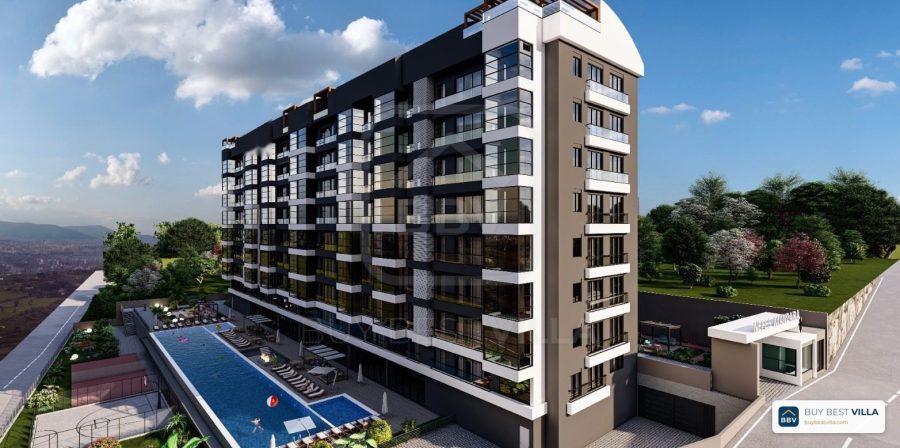
Nefes Premium
A three-block, 56-unit residence in Kepez with a 350 m² pool, tennis court, jogging track, garden duplexes and penthouse duplexes with private pools. From 2+1 to 4+1.